CalxFluor™ Series

CaSiR-1 pottasium salt

[Calcium ion detecting probe]

650-750 nm:Far red

CaSiR-1 is a far-red fluorescent calcium indicator. The core structure of CaSiR-1 is based on silicon rhodamine and the probe emits fluorescence with a maximum emission wavelength of 609 nm. CaSiR-1 has high photostability, allowing for continued stable observation over relatively long periods of time. Due to the longer wavelength fluorescence of CaSiR-1, the probe is characterized by low cytotoxicity and low background in vivo imaging.


CaSiR-1 was commercialized by Goryo Chemical Company under the guidance of Prof. Tetsuo Nagano (Professor of Laboratory of Chemistry and Biology, Graduate School of Pharmaceutical Sciences, The University of Tokyo).


Products

Code No. Product Name Size Merck CAT No. Merck ( Millipore / Sigma Aldrich )
Product Name
GC405 CaSiR-1 potassium salt 500 µg
  • Product Information

    Print

    Properties of CaSiR-1

    Product Name Target Reaction Absmax (nm) FLmax (nm) Kd for Ca2+
    Φ
    CaSiR-1 Ca2+ reversible 650 664 0.58 μM 0.20

    CaSiR-1 is a far-red fluorescent calcium indicator. The core structure of CaSiR-1 is based on silicon rhodamine and the probe emits fluorescence with a maximum emission wavelength of 664 nm. CaSiR-1 has high photostability, allowing for continued stable observation over relatively long periods of time. Due to the longer wavelength fluorescence of CaSiR-1, the probe is characterized by low cytotoxicity and low background in in vivo imaging.


  • An imaging example using CaSiR-1 AM

    Print

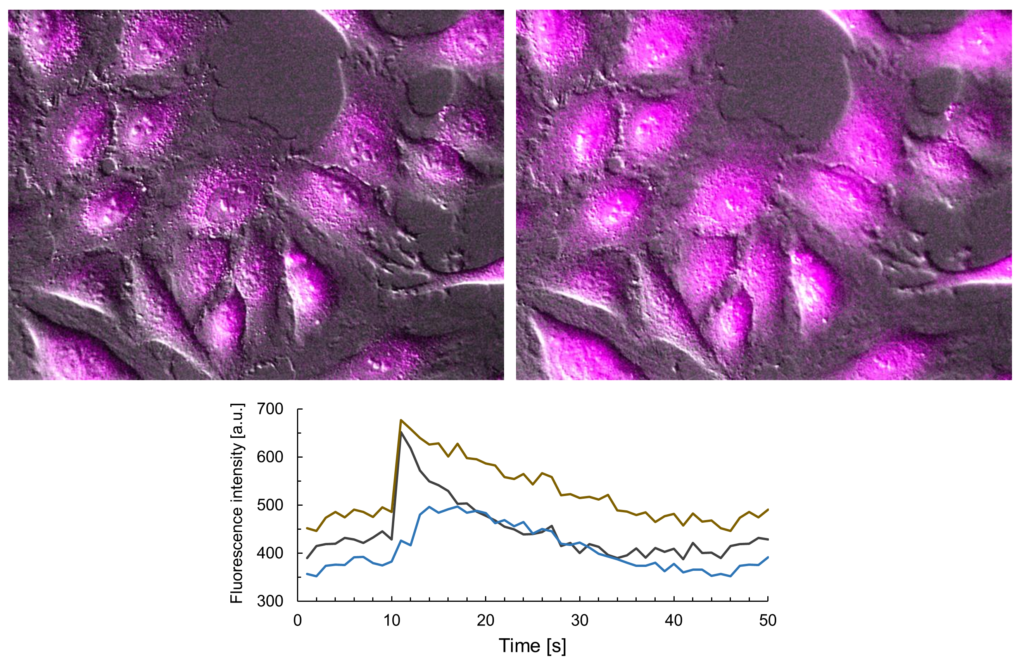
    An imaging example using CaSiR-1 AM


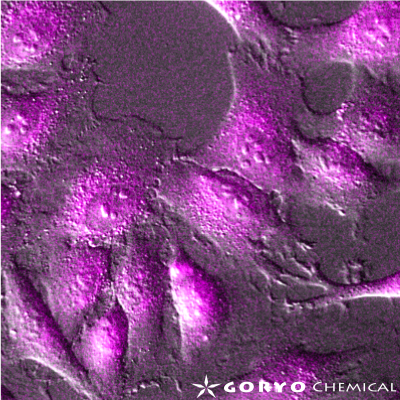
    Calcium oscillation of HeLa cells stimulated using histamine. Above photo indicates an overlay of DIC image (gray) and fluorescence signal from CaSiR-1 (magenta). Graph below indicates fluorescent intensity changes in a couple of spots of the images.

    Refer the reference list for more examples.


FAQ

  • Q Do I need to add Pluronic F-127 to load the probe into the cells?
    A

    It has been reported that addition of Pluronic F-127 is not required to load CaTM-3 AM into cultured cells. For other cases, addition of Pluronic F-127 is recommended.  Refer the protocol document of each probes for the requirement and procedures. Pluronic F-127 also inhibits the aggregate formation of the probe in addition to increase cell permeability.


  • Q Do the probe fluoresces by other cations?
    A

    It has been reported that it does not fluoresces in the presence of neither < 1 mM  of Mg2+ or  < 100 mM of  Na+ and K+. Refer the following paper:

    Egawa, T.; Hanaoka, K.; Koide, Y.; Ujita, S.; Takahashi, N.; Ikegaya, Y.; Matsuki, N.; Terai, T.; Ueno, T.; Komatsu, T.; Nagano, T. J. Am. Chem. Soc. 2011, 133, 14157-14159

  • Q I could not find my question in this list, yet.
    A

     Contact us if your question has not been solved.